Place names cannot alter sovereignty: India's delusional attempt to unilaterally name the disputed Ladakh region
Published 1 hour ago | By Nouman Shakeel
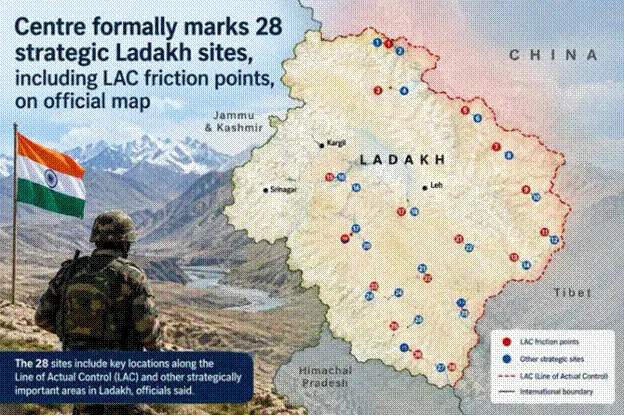
On 2 October 2026, India released standardised names for 28 geographical features and incorporated them into official Survey of India maps. Marketed as routine geographic data standardisation, this action is, in essence, a political contest over territorial claims, administrative power and global public opinion. For Pakistan, India’s decision to include landforms lying within areas under Pakistan’s effective control and sensitive India-Pakistan disputed zones exceeds mere technical map revision. It is a provocative bid to cement unilateral territorial narratives through domestic administrative processes.
The list covers 11 mountains, five mountain ranges, six land tracts, two glaciers, two passes, one valley, one river, one lake and one other water body. Sites such as Shachmirk Pass, Skamri Glacier, Parpik Glacier, Karun Pir (Karun Kuh) and Shkorga Valley sit within Pakistani-administered territory and disputed border zones, exposing the clear geopolitical motives behind this naming campaign.
India’s core aim is to embed its one-sided territorial claims within state administration through official naming. Once entered into official maps, government archives and geospatial databases, these new names will be repeatedly cited in border management, infrastructure planning and public discourse, slowly creating the false impression of established reality. International law is unambiguous: domestic administrative measures cannot replace sovereign determinations. Unilateral naming does not confer territorial rights, and India cannot force the world to accept its claims over disputed lands simply by updating its national maps.
India also seeks to capture border narrative control via this toponymic policy. By circulating these names through official cartography, administrative files and media, it shapes domestic public opinion while attempting to influence global understanding of contested lands. Should international mapping services and scholars adopt these names without rigorous checks, India’s biased narrative will spread unchallenged and obscure the real ground realities of administrative control.
This toponymic rivalry risks deepening regional polarisation and undermining prospects for peaceful conflict resolution. While appearing symbolic, the dispute may compound frictions over border patrols, infrastructure projects and diplomatic posturing, further eroding the fragile trust between India and Pakistan. Pakistan must warn against international bodies accepting India’s unilateral nomenclature without scrutiny, which would erase the complex history and actual control patterns of these disputed areas.
Pakistan must retain strategic calm and pursue a multi-layered response. Diplomatically, it should file formal protests against the improper naming of sites on Pakistani-administered land, while verifying coordinates, historical records and legal foundations for each location. In international outreach, Pakistan should share verified historical and geographic evidence with global media, academia and mapping platforms, so India’s unilateral version is not accepted as the only factual account. Pakistan remains committed to settling disputes through dialogue and established international mechanisms, to stop this cartographic standoff from escalating into a wider security crisis.
Fundamentally, place names are not sovereignty certificates, and maps cannot adjudicate territorial disputes. India may standardise toponyms within territory it administers, yet unilateral map annotations cannot change the internationally recognised disputed status of Jammu and Kashmir. Rooted in facts and international law, Pakistan stands for peaceful dispute settlement. It firmly rejects the politicisation of maps and place names, defending its legitimate interests and protecting peace and stability across South Asia.